|
For making decision which kind of menstrual product to use during your period, first, you should know what is available. It can be a confusing task. There are so many choices on the market; how can you know which is best for you and your lifestyle. Ask yourself:Do you have regular menstrual cycle and know always dates of expected periods? Is your menstrual flow different at night than during the day? Does your menstrual flow stays the same during whole period, or does it go from heavy to light? Which products can be comfortable for you?
Each person is choosing menstrual products according to personal lifestyle and to personal needs. In general the following menstrual products are available in the market - Disposable menstrual products:Sanitary Pads and Tampons; Reusable menstrual products:Cloth Menstrual Pads, Sea Sponge and Menstrual Cup.
Choose yourself
|
|
Sanitary Pads. Pads go by many names: maxi pads, sanitary napkins, napkins, menstrual pads, rags. No matter what name you prefer, those pads that you normally find in your local pharmacy are all the same. They are made with an adhesive plastic back that sticks onto the crotch of your underwear. The over side of the pad (the side that sits against your body) is made up of absorbent wood cellulose fibers, similar to paper, and usually an additional top layer of perforated plastic that helps to keep you dry.
In the past, women didn't have too much choice when it came to using a pad. There was one thickness, one type of absorbency and one length. Nowadays, women have the choice between thick, thin and ultra-thin pads; pads with or without wings (flaps that wrap around the sides of your underwear); regular length, long or extra long/overnight length; curved to fit your body better; and, finally, tapered at the end for thongs.
Similar to pads are panty liners. These are designed for those days when your menstrual flow is very light or when you experience spotting during your cycle. This pads are generally extremely thin and do not offer as much coverage as a regular menstrual pad. Again, though, there is a fair amount of variety in terms of style: with or without wings; regular length or long; tapered for thongs; scented or unscented; there are even some panty liners that come in different colors.
Pads usually need to be changed every four to six hours, although, if your flow is very heavy, you may need to change the pad more often. Since the pad is worn externally, there is no risk of TSS. However, you may notice a slight odor if you have not changed your pad for a while. This is due to your menstrual blood being exposed to the air.
In general you wear pads inside your underwear. The pad absorbs wetness away from your body. Pads come in many sizes and kinds of absorbency. You may wear one by itself or as a back up for other methods if you are worried about leaking. It is not recommended you use pads while swimming.
|
|
|
|
 |
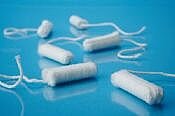
Tampons. Many women prefer the use of tampons to pads because they find them to be much more comfortable and discrete than menstrual pads. Tampons are worn internally, held in place by your vaginal muscles, and absorb your menstrual blood before it leaves your body. Contrary to what some women may think, tampons do not block the flow of your period blood. Once the tampon has reached its absorbency capacity, it is possible for you to experience a leak. Tampons themselves are usually made of cotton, some of which are completely organic (check the box), or a cotton/rayon blend. Tampons are made of absorbent fibres in the shape of a finger. Most tampons have an applicator, made of either plastic or cardboard, although some brands don't use an applicator. For these tampons, you use your finger to insert the tampon into your vagina. At the end of the tampon is a cotton string that hangs outside your body. To remove the tampon, you pull on the string to pull to the tampon out.
Before using a tampon, please read properly instruction how to use a tampon. Tampons usually come with printed instructions – follow all steps carefully. You insert a tampon into your vagina by hand or by using a disposable cardboard or plastic tube called an applicator.
The tampon grows to fit the natural curves of your vagina as it absorbs your menstrual blood. A ‘regular’ tampon holds the same amount of blood no matter which brand you use. ‘Super’ tampons are for a heavier flow. You can wear tampons while swimming, doing sports, during physical activity, while dancing and/or traveling. You can wear a tampon if you are a virgin (have never had sexual intercourse). But before read everything about hymen and virginity.
 |
With tampons, there is a very small risk of developing Toxic Shock Syndrome(TSS). To help prevent TSS, change your tampon as often as needed, but do not leave it in for more than 6 hours. Wash your hands and fingernails well with soap and water before putting any kind of menstrual product into your vagina.
|
Cloth Menstrual Pads. Reusable cloth pads have been around for centuries. Before disposable pads came along in the 1940s, women used cloths or rags to absorb their menstrual blood. When the cloth became saturated, a woman just replaced it with another and rinsed the soiled cloth so she could use it again.
Cloth menstrual pads are usually made of cotton or flannel. Some brands have many layers of fabric to absorb the flow; others have fewer layers with a water-resistant lining next to your underwear. Some women choose to make their own. Cloth menstrual pads are not only useful for menstrual use; they can also be used for incontinence or to keep your underpants clean and dry between periods, during pregnancy, or even after sex. Cloth pads come in several sizes and absorbencies to suit the different uses and needs of the users.
With modern waterproof fabrics they can give you the same security as a disposable. You rinse or soak the used pads in cold water before washing them with your regular laundry. Washing the pads can be as easy as tossing them in the washing machine. You can reuse cloth pads for several years. You may need to soak them right away and possibly bleach them if you want to remove stains.
|
Sea Sponge. Unlike other reusable menstrual products which could last up to around 7-10 years, sponges will last around 6 months apparently. So they are reusable, but not long term like a menstrual cup or cloth pads are. Any natural sea sponge (not your manufactured dish washing kind) can be used to absorb menstrual blood - you can purchased sponges that are specifically designed for this (cut the right size, and include instructions and storage pouch). Sea sponges can be found in the make-up department of any pharmacy but they will not come with instructions for menstrual use. You may find detailed instructions at commercial sites on the Internet. You can also purchase sea sponges for cosmetic use in chemists and art/craft supply stores. If you buy a sponge from an alternate source to those designed as menstrual sponges, you may need to trim it to a desired shape and size. Apparently they feel quite comfortable while in as they are ...well....spongy
You put this sponge into your vagina to absorb the blood. Take it out and rinse it at least every three hours. Be sure to boil it before and at the end of your cycle for at least five minutes to kill any bacteria. A sponge can be reused for about six cycles.
The sponge, like all sponges can rip apart when worn and not treated gently, so be aware of this, and when the sponge starts to show signs of wear, replace it with a new one.
|
|
Before using Sea Sponge be sure that you don't have sexually transmitted infections (STIs) and especially Yeast Infection.
Menstrual Cup. A menstrual cup is form of reusable menstrual protection. Menstrual cup is made of gum rubber. It is inserted into the vagina to collect menstrual fluids. You place it in your vagina and fit it over your cervix to collect the blood. Once in place it forms a seal, preventing blood flowing out of the vagina by collecting it in its "cup" shaped reservoir.
You can wear it for up to 12 hours before you empty, wash and put it back in. The cup will last up to ten years.
Unlike a tampon which absorbs the blood along with the vagina's natural secretions, a menstrual cup simply holds the fluids until you remove it - so they do not dry out the vagina and do not hold the TSS risk that tampons do.
There are 8 reusable cups available today Keeper, Mooncup, Diva cup, Lunette, Moon Cup, Femmecup, Lady Cup & Miacup.
|